
Why F1 Cars Are Just Math Equations Doing 300km/h
"Sometimes a car is a mechanical marvel. Sometimes it's a Partial Differential Equation trying not to crash."
Topic: Formula 1 Aerodynamics
Severity: P0 — One wrong equation and your car is a $15 million shopping cart
Root Cause: Air is invisible, heavily opinionated, and hates you
Resolution: Throwing supercomputers at the problem until it behaves (or until the FIA bans your design)
The Invisible Brick Wall
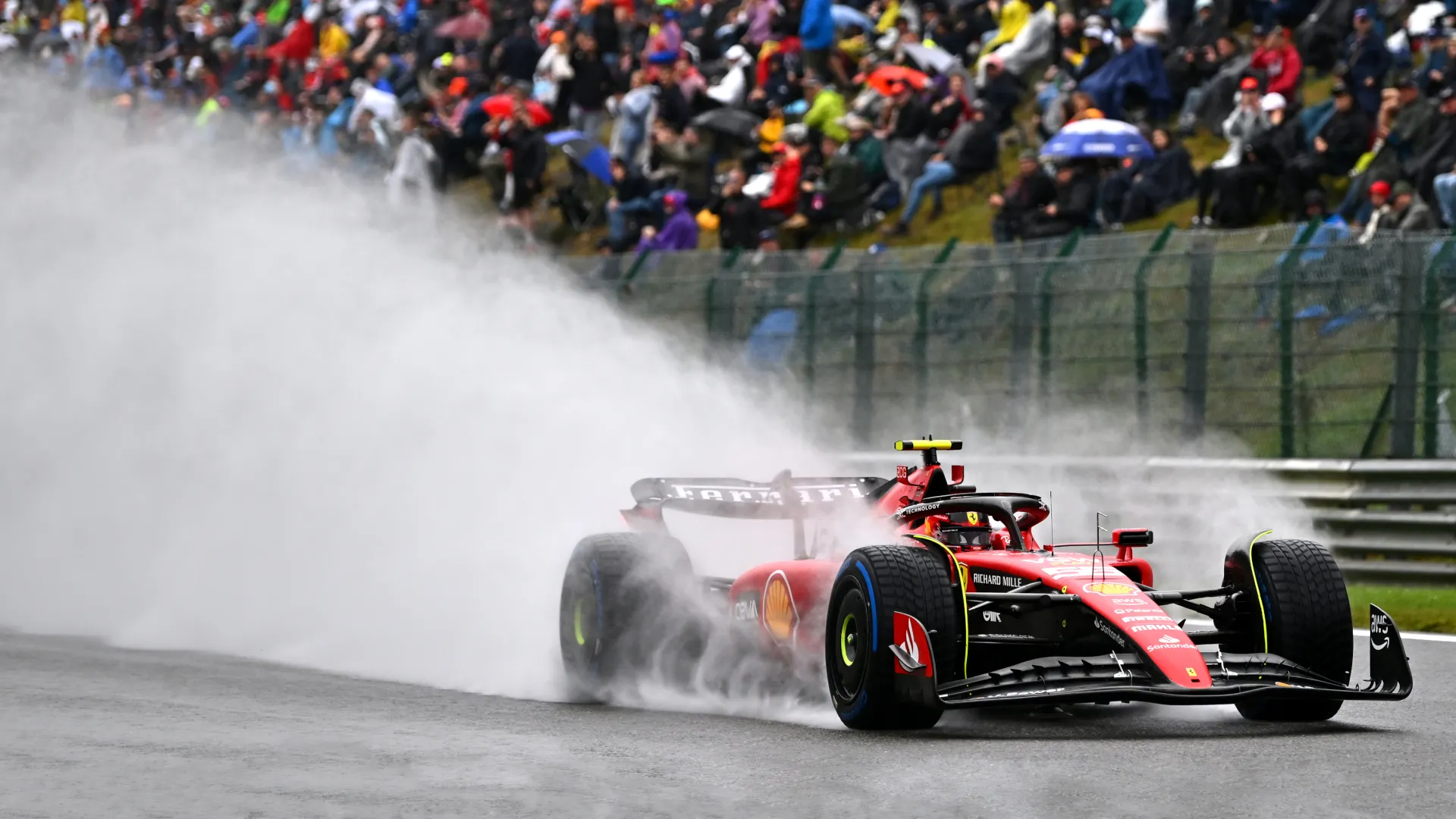 Water Spray and Turbulence
People think Formula 1 is about mechanical engineering. Build a big engine, slap on some tires, and drive fast.
That description is accurate, but horribly incomplete.
At speeds exceeding 300 km/h, the air itself becomes your biggest enemy. It stops feeling like a gas and starts acting like an invisible brick wall. A poorly designed aerodynamic profile means your car is fighting a hurricane of its own making. You don't just get drag; you get unstable airflow, reduced grip, overheating, and a driver screaming on the radio that the car drives like a tractor.
F1 engineers aren't just mechanics anymore. They are designing invisible pressure fields and thermal flows.
Modern Formula 1 is not won in the garage. It is won by mathematics transformed into computation.
When Math Fails: Flying Cars and Metal Kangaroos
What happens when the aerodynamic mathematics go wrong? The physics engine of reality punishes you instantly and violently.
1. The "Porpoising" Disaster of 2022 Remember when half the grid's cars were violently bouncing up and down like angry metal kangaroos, giving drivers literal spinal damage? That wasn't a mechanical failure. That was an aerodynamic miscalculation. The math said the car would create suction. But it created too much suction, pulling the car so close to the ground that the airflow choked. The downforce broke, the car popped up, the air rushed back in, the downforce returned, and the car slammed back down. This repeated 10 times a second. Somebody’s mathematical model failed to predict the real-world pressure stall, and they spent half the season apologizing to their drivers' chiropractors.
2. The Inverted Airplane (Webber, Valencia 2010)
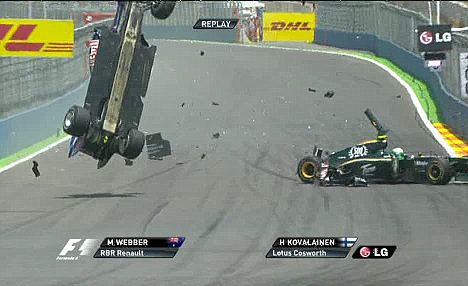 Mark Webber Flying Car
Mark Webber famously did a full 360-degree backflip in the air after hitting Heikki Kovalainen's rear tire in Valencia. When an F1 car's nose points up too high, the mathematical equation for downforce completely inverts. The flat floor, which is supposed to suck the car to the ground, catches the air like a massive kite. The car literally forgets it is a car and briefly becomes a very poorly designed airplane.
3. "Brake Magic" (Hamilton, Baku 2021) This was a thermal math and systems failure. Mercedes has a button called "Brake Magic" that shifts brake bias heavily to the front to generate heat (using the Heat Equation) during safety cars. Lewis Hamilton accidentally bumped this button on a restart. The system math told the car to send all the braking force to the front tires, which instantly locked up, sending him straight into the runoff area and costing him a race win. A one-bit input error completely destroyed the deceleration vector.
The Final Boss: Partial Differential Equations
Ordinary math is useless here.
Airflow depends on multiple continuously changing variables simultaneously: velocity, pressure, density, time, and your precise coordinates in 3D space. To model this, you need Partial Differential Equations (PDEs).
Unlike the equations you suffered through in high school that dealt with one changing variable (shoutout to solving for X), PDEs describe systems that vary across both space and time.
And the absolute final boss of them all is the Navier–Stokes Equation:
This terrifying sequence of symbols mathematically describes fluid motion. It models velocity changes, pressure forces, viscosity, and momentum transfer.
If you ever feel stupid, just remember that the smartest physicists in the world have a literal $1 million prize waiting for anyone who can mathematically prove that this equation always works smoothly in three dimensions. They still haven't claimed it.
In Formula 1, the "fluid" is air. And taming this equation is the only thing standing between winning a championship and spinning into a wall.
Turbulence (The Unsolved Problem)
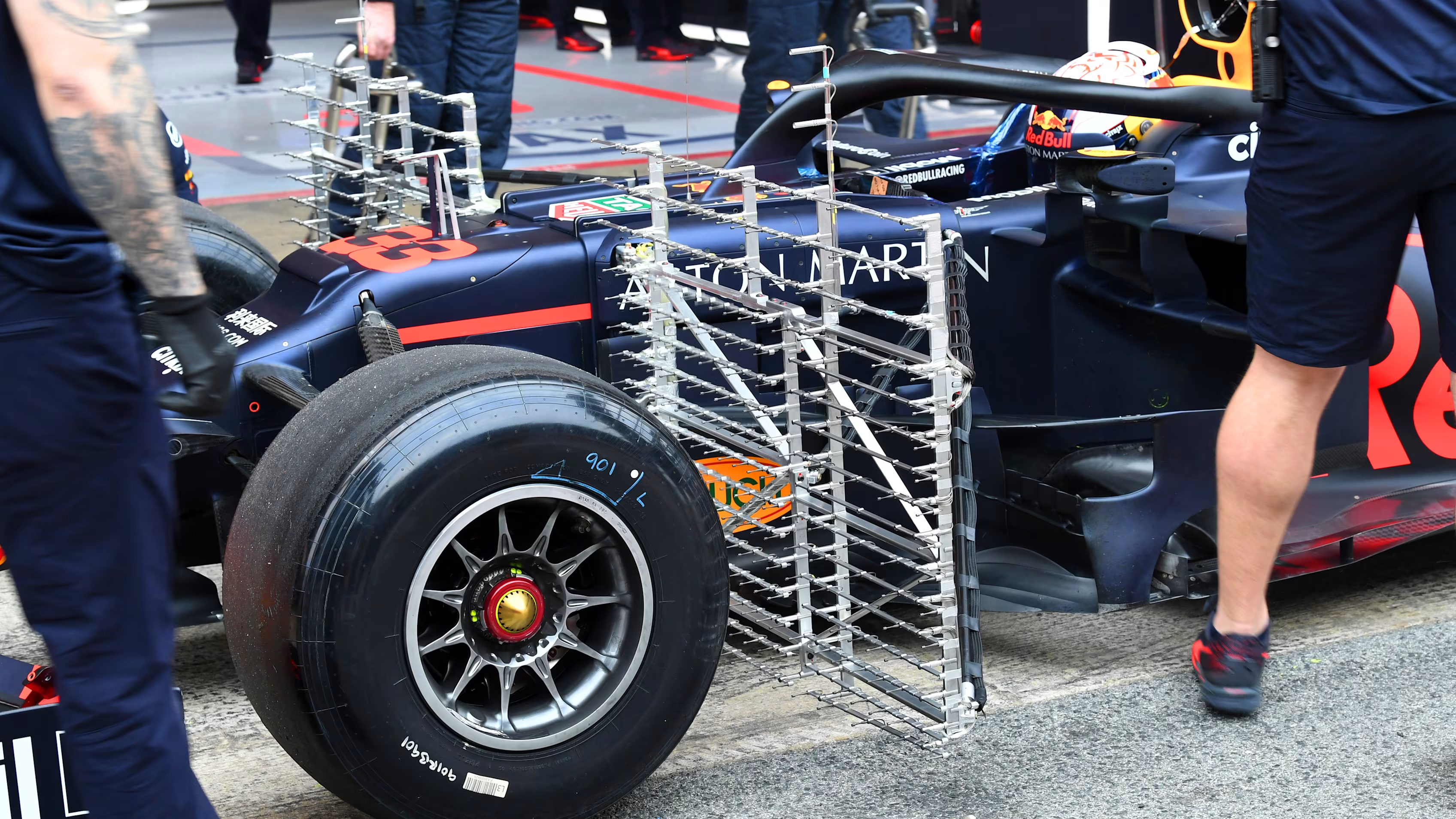 Aero Rake Testing
Here is a fun fact: Turbulence is one of the hardest unsolved problems in all of physics.
At racing speeds, airflow separates, swirls, and becomes completely chaotic. Tiny disturbances evolve into complex, chaotic patterns that destroy your rear grip. If you are a driver following another car, you are driving into "dirty air"—which is basically an invisible blender. You lose up to 40% of your downforce just because the guy in front of you messed up the math of the air you're trying to drive through.
The difficulty isn't just physical. It is computational. Solving turbulent Navier–Stokes equations exactly for a full F1 car in real time is practically impossible, even if you daisy-chain the world's best supercomputers together.
Humanity went to the moon, built artificial intelligence, and split the atom before fully solving turbulence. A deeply human sequence of priorities.
Because of this, F1 teams have to rely on approximations and educated guesses.
Bernoulli’s Principle: How Not To Fly
The ultimate goal of F1 aero is generating downforce.
Downforce pushes the car into the track, increasing tire grip and allowing cornering speeds that should legally require a pilot's license. We explain this using Bernoulli’s Principle:
As airflow speed increases beneath the floor and wings, pressure decreases. This pressure difference creates a massive vacuum effect.
Airplanes use this exact same principle to stay in the sky. F1 cars use it to avoid flying into the sky. It is literally the same math, just mounted upside down.
Let's Actually Do the Math
To prove this isn't just theory, let’s calculate the downforce on a simplified F1 front wing entering a corner at 288 km/h (80 m/s).
- ▹Air density (ρ): 1.225 kg/m³ (standard sea level)
- ▹Velocity over the wing (v₁): 80 m/s
- ▹Velocity under the wing (v₂): 100 m/s (The wing's shape forces the air under it to travel faster)
Using Bernoulli's equation, we can find the pressure difference (ΔP) between the top and bottom of the wing:
If the effective area of our front wing is 1.5 m², the total downforce generated is:
That’s roughly 337 kg (9 G's worth of force) pushing the front tires into the asphalt just from the air passing over one component.
Without this suction, taking a corner at 250 km/h would result in the car sliding away horizontally, governed only by inertia and a distinct lack of grip.
CFD: Throwing Computers at Math
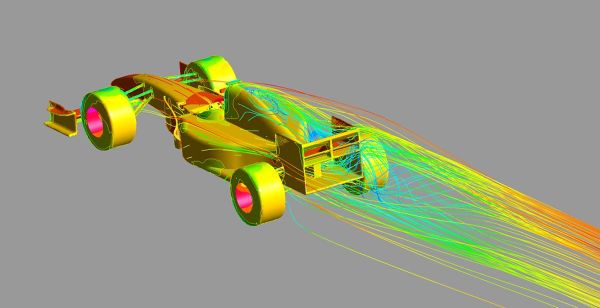 CFD Simulation
Since we can't solve these PDEs analytically by hand (unless you want to spend 400 years calculating one front wing endplate), teams use Computational Fluid Dynamics (CFD).
CFD converts these nightmarish mathematical equations into numerical simulations. It works like this:
- ▹Mesh Generation: Divide the car's airspace into millions (sometimes billions) of tiny 3D cells.
- ▹Discretization: Convert continuous PDEs into solvable algebraic approximations for each individual cell.
- ▹Wait: Let the supercomputer do the heavy lifting, calculating how air moves from cell A to cell B.
Running a high-fidelity CFD simulation of a full car makes a standard high-end gaming PC look like a pocket calculator from 1995. The finer the mesh, the more accurate the simulation. But it also means a brutally higher computational cost.
Opening the Black Box: How Discretization Actually Computes
How do you make a computer solve continuous calculus? You don't. You turn it into algebra using the Finite Difference Method (FDM).
Take a simple velocity derivative over space (∂v/∂x). A computer doesn't understand continuous math. So, CFD approximates it using the discrete cells of the mesh:
Where v[i] is the velocity in the current cell, v[i+1] is the next cell, and Δx is the physical distance between them. Suddenly, you aren't doing calculus anymore. You are running a massive for loop, solving basic arithmetic to update the pressure and velocity of each cell at Time = T+1.
Multiply this loop by 3 dimensions, 50 million cells, and 10,000 time steps. Running a high-fidelity CFD simulation of a full car makes a standard high-end gaming PC look like a pocket calculator from 1995. The finer the mesh, the more accurate the simulation, but the computational cost scales brutally.
The Correlation Nightmare
The biggest fear for an aerodynamicist isn't a slow simulation. It's correlation failure. This is when your multi-million dollar CFD math says your new front wing will give you 0.2 seconds a lap, but when you bolt it onto the physical car, it actually makes you 0.5 seconds slower. The computer lied. Your mathematical model didn't match the chaos of the real world. Teams have thrown away entire seasons (looking at you, Aston Martin and Mercedes) because their simulation math didn't correlate with reality.
The Heat Equation: Why Tires Are Black Magic
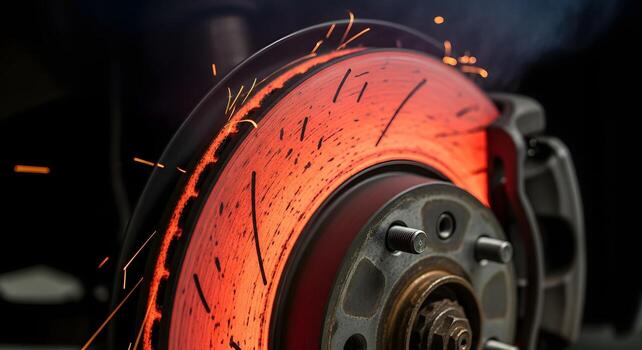 Glowing Brakes
It doesn't stop at air.
- ▹Brakes: Routinely exceed 1000°C. They get so hot they glow like the Eye of Sauron.
- ▹Tires: Continuously heating and cooling based on the friction vector.
Pirelli tires are basically black magic circles of rubber. They grip like superglue when their core temperature is exactly 100°C, but if they drop to 95°C, you might as well be driving on wet ice.
Managing this requires the Heat Equation (∂u/∂t = α∇²u), another PDE that models how heat diffuses through materials over time. Engineers use it to model brake cooling channels and thermal efficiency. One small thermal imbalance and your race strategy goes straight in the bin.
When Math Saves Your Life: The Halo and FEA
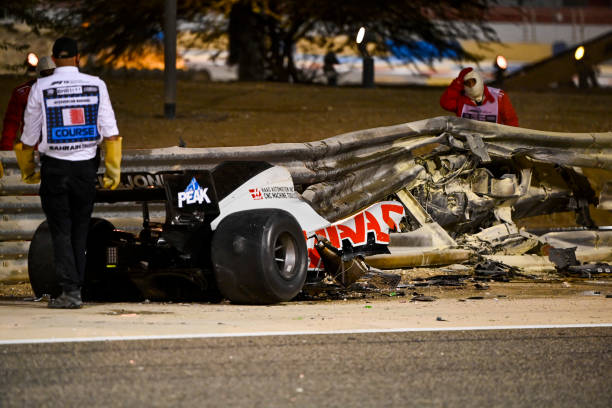 Grosjean Halo Aftermath
While CFD handles the fluid math, Finite Element Analysis (FEA) handles the structural math. And there is no greater triumph of FEA in modern motorsport than Romain Grosjean’s horrific crash in Bahrain in 2020.
Grosjean hit the steel barrier at 192 km/h, experiencing a massive 67 G-force deceleration vector. The car split in half and instantly erupted into a fireball.
The reason he walked away is the Halo—the central titanium structure protecting the driver's head. The Halo wasn't just welded together on a hunch. It was computationally modeled using FEA (another numerical method that solves structural PDEs across a 3D mesh) to withstand 125 kiloNewtons of force. That is roughly equivalent to balancing two African elephants on a piece of metal above the driver’s head without it yielding.
When the car pierced the barrier, the math held up perfectly. The barrier broke, the chassis split, the fuel ignited, but the mathematical structural integrity of the survival cell and the Halo did exactly what the equations predicted. The math literally saved his life.
Monte Carlo: The Strategy Matrix
We haven't even talked about the pit wall.
"Box box, pit confirm." This decision isn't made by a guy with a stopwatch. It's made by algorithms. Teams run Monte Carlo simulations—a mathematical technique that runs tens of thousands of random race scenarios in the background while the cars are actually driving.
It factors in tire degradation curves, the probability of a safety car, fuel loads, and the pace of the guy 10 seconds behind you. The strategy team is basically playing four-dimensional chess, using statistics to predict the future, while the driver is complaining about a weird vibration in turn 4.
Current Status
What This Actually Teaches Us
- ▹Math isn't abstract. In F1, math is a physical, violent force pushing a carbon fiber chassis into the asphalt at 5G.
- ▹Approximation is an art. We still can't definitively solve turbulence, so we cheat with numerical methods and massive compute power. Smart engineering is knowing how to cheat efficiently.
- ▹Everything is Optimization. From the angle of a wing flap to the thermal curve of a brake duct, the entire car is just a thousand iterative mathematical optimizations converging on one goal: speed.
Behind every corner taken at extreme speed lies an enormous invisible mathematical infrastructure.
The modern Formula 1 car is not just a machine. It is mathematics moving at 300 kilometers per hour.
Written by Ganesh Angadi
DevOps Engineer • Backend Engineer • Platform Engineering